


No products in the cart.

BPI Building Analyst Certification
This complete package will give you everything you need.
If you want to get BPI Certified to offer home energy audits, the Building Analyst Package is the right choice for you!
We've included all prerequisites and exams in this one package, so that you're equipped with all the necessary knowledge and skills.
ONLINE or BLENDED
BEGINNER LEVEL
66 HOURS
WHY GET BPI CERTIFIED
Benefits of BPI Building Analyst Certification
A BPI Building Analyst Professional is a person who evaluates uncontrolled air leakage into and out of a home and identifies heating and cooling problems that lead to high energy costs, health problems, and occupant discomfort.

Upskill Quickly
Build upon your trade skills with a nationally-recognized certification!
Gain New Clients
If you already work for a HVAC or trade company, you can add home energy auditing as a new service and reach more customers!
Grow Your Business
Qualify for utility rebate programs that require technicians with BPI Certification.
"I learned more than I could expect. You could tell the instructors are both very passionate about what they teach. That helped me get into the class and become just as passionate. I'm looking forward to taking more classes with these instructors. Thank you."
- Jeff Elsasser
HOW IT WORKS
How to Get BPI BA Certified
Our BPI training classes include everything that you need to get certified.

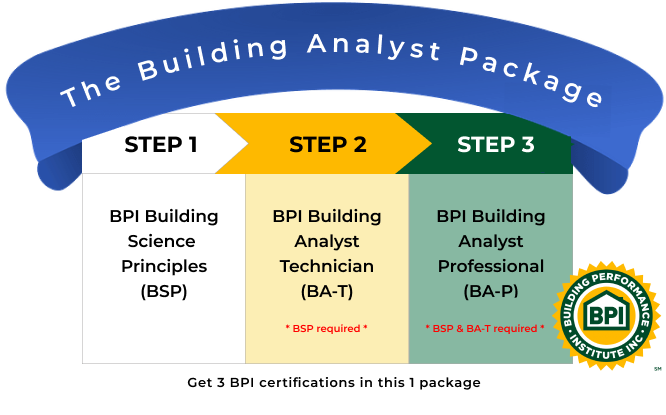
1. Pass the BPI BSP Exam
The BPI Building Science Principles (BSP) certificate of knowledge is a required first step for anyone pursuing BPI Certification.

2. Pass the BPI BA-T Exam
The BPI Building Analyst Technician (BA-T) is the next required step before attempting the BPI Building Analyst Professional (BA-P) certification.

3. Pass the BPI BA-P Exam
Simply register for this "Building Analyst Package," which includes BSP, BA-T, and BA-P. Save time & money now, and reap the benefits of getting all necessary training and exams in one place.
TOPICS
BPI Building Analyst Course Topics
Our BPI Building Analyst certification course is aligned with the Building Performance Institute's (BPI) standards for home energy auditing and teaches you how to use building science to diagnose a home's energy issues.

What You'll Learn
- Principles of Energy
- Basics of Heat, Moisture & Airflow
- Building Structural Elements
- Types of Insulation
- Building Mechanical Elements
- Blower Door & Pressure Diagnostics
- Combustion Safety
- Common Problems & Solutions
- The Energy Audit Process
- Health & Safety
WHAT'S INCLUDED
BPI Course Materials
Regardless of which format you choose – Online or Blended – you will receive:
Everything You Need to Succeed
- Building Science Principles online training & exam
- Equipment skills training
- BPI Building Analyst Technician field exam ($700 value)
- BPI Building Analyst Professional written exam ($400 value)
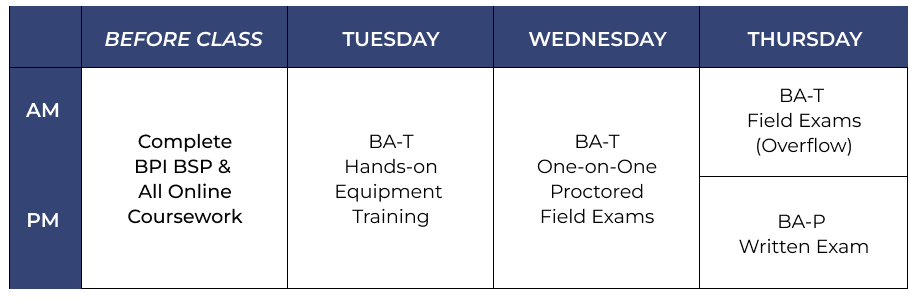
If you register for our blended course, you will watch our online training videos and then appear in person for hands-on field training with equipment and your written/field certification exams.
If you sign up for our online class you will watch our online training videos and then schedule to have your written/field certification exams proctored when you're ready.
SCHEDULE
Choose Your Location & Time
We also offer corporate training. Schedule when it's convenient for your team, and we'll conduct training at your location!
Location
Location Info
Date
Time
Don't see a location near you? Contact us to schedule a group session when it's convenient for your team!
SOLD OUT
8 AM - 5 PM
8 AM - 5 PM
8 AM - 5 PM
SOLD OUT
SOLD OUT
8 AM - 5 PM
8 AM - 5 PM
SOLD OUT
8 AM - 5 PM
8 AM - 5 PM
8 AM - 5 PM
SOLD OUT
8 AM - 5 PM
8 AM - 5 PM
8 AM - 5 PM
SOLD OUT
8 AM - 5 PM
SOLD OUT
SOLD OUT
SOLD OUT
8 AM - 5 PM
PRICING
Register for the BPI Building Analyst Package
This package satisfies all BPI prerequisites so you can fast-track to the highest level of Building Analyst Certification.
Online
Package includes BSP + BA-T + BA-P
Instant access to online video training
Follow along 24/7 for 6 months
Includes all written & field exams
Need to have energy auditing equipment
Schedule exams at your convenience (remotely)
Blended
Package includes BSP + BA-T + BA-P
Instant access to online video training
Follow along 24/7 for 6 months
Includes all written & field exams
Join us for hands-on equipment training
Take your written & field exams in person
"The class was well organized, well run, and led by what should be considered leaders in their field. I would freely recommend Everblue for individuals seeking a program with solid support and results."
- Michael Trudeau
FAQs
Quick Answers to Your BPI BA Questions
Who is this class intended for?
What energy auditing equipment will I need?
If you register for our blended format, we will provide all equipment for the training and testing. If you register for the online (self-paced) format, you will need to buy, borrow, or rent the following equipment:
- Combustible Gas Detector (Gas Sniffer) that provides a digital display of percentage of Lower Explosive Limit (LEL) and/or provide an alarm when detecting combustible gas concentrations exceeding 10% Lower Explosive Limit (LEL)
- Combustion Analyzer equipped internally or externally with a nitric oxide filter (NOx filter)
- Ambient CO monitor
- Mirror, smoke pencils or other smoke visualization equipment for depressurization and spillage assessment
- Complete Blower Door Testing Kit including hoses, blower door frame, blower door canvas, etc.
- One or more manometers
- Pressure Pan and associated kit
- Exhaust Fan Flow Meter and associated kit
- Duct Blaster and associated kit
- Infrared camera (optional)
When you register for this course, you will automatically receive energy auditing equipment discounts from leading equipment manufacturers, such as Retrotec, The Energy Conservatory, and TruTech Tools.
What are the requirements for the field testing site?
If you register for our blended format, we will provide the site for the field training and testing. If you register for the online (self-paced) format, you must find a home that meets these requirements:
- Must have at least one atmospherically vented combustion appliance
- A ducted distribution system (must contain ductwork)
- Exhaust fan
- Gas Oven or an Electric oven for simulation purposes
- Accessible attic
Are the exams included with this course?
Yes. If you take the blended version of the course, you'll complete your written and field exams at the end of the week.
If you took the online version of the course, you will need to find a home that meets the BPI Standard, obtain the required field equipment, and contact us to proctor your exam when you're ready.
How do I begin the online training?
How soon after taking my exam am I certified?
You will know your written exam score immediately upon completion. We are required to submit your field exam score to BPI within 24 hours. BPI will ultimately determine whether or not you passed the field exam and will share your certification status in their online candidate portal. BPI will mail out a paper certificate and ID card, within 4-6 weeks after certification is awarded. However, you may begin work functions immediately after you confirm your certification status online.